


We Build It. We Ship It. Here Is What That Means for UAE Clients.
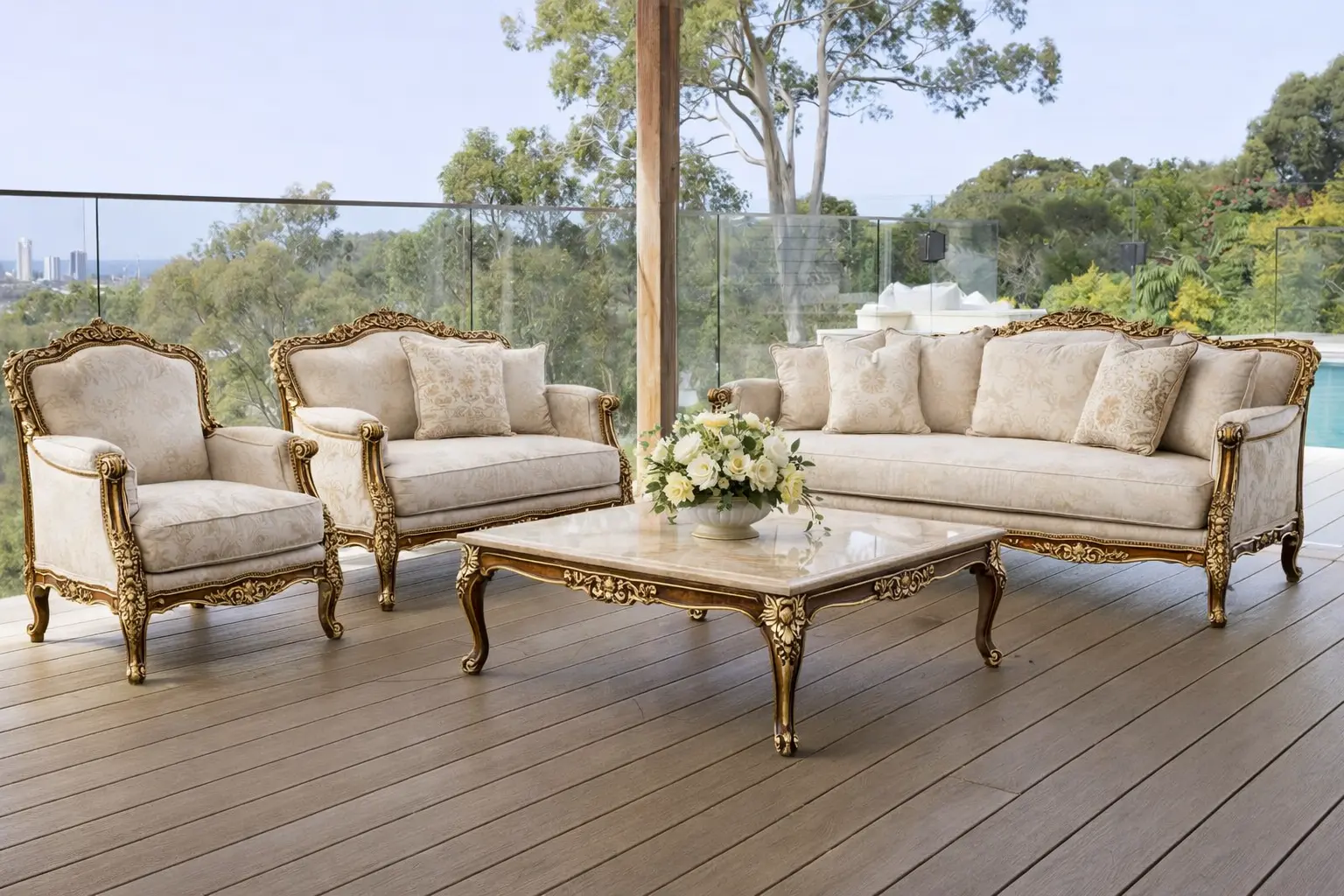
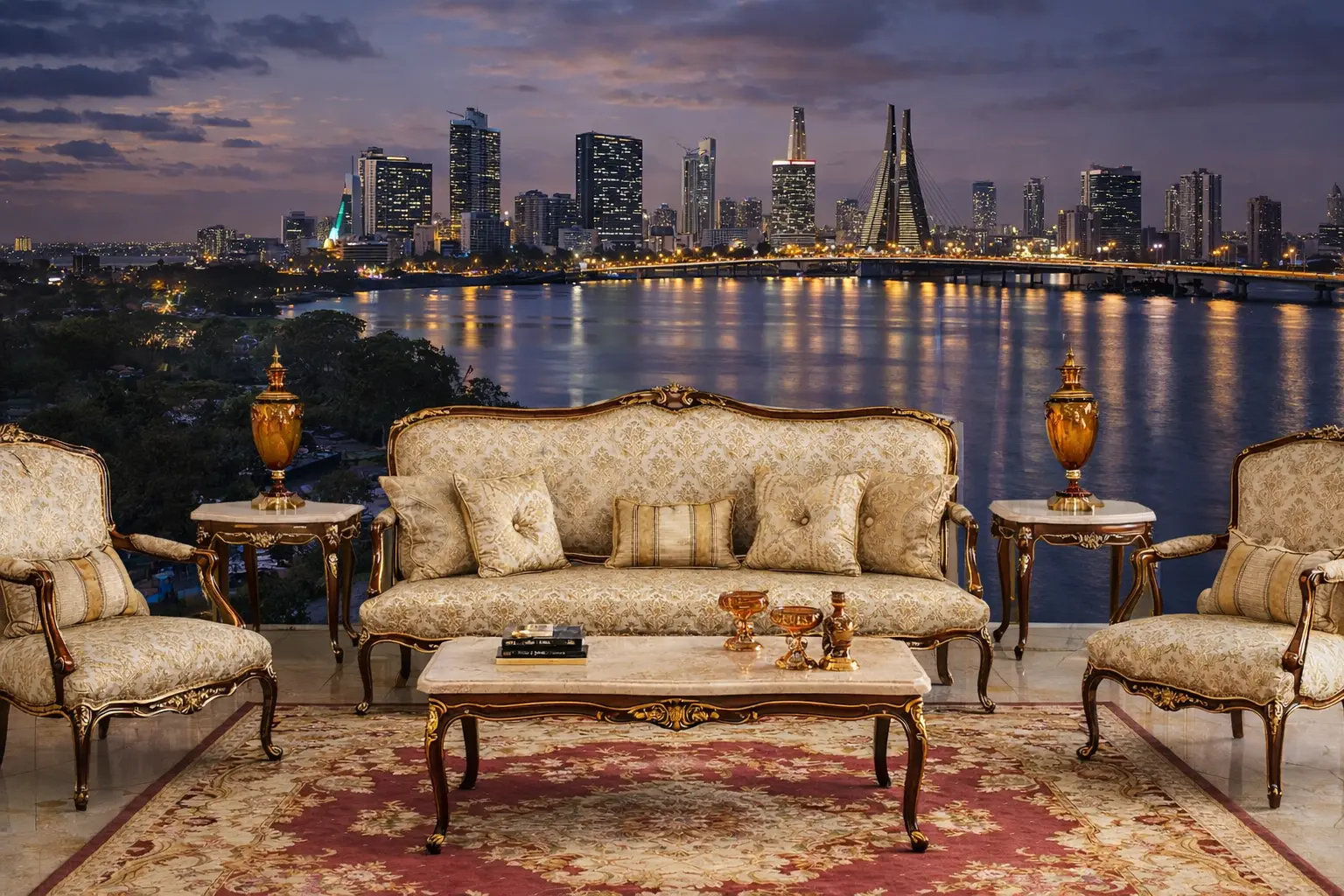
Welcome to Royalzig! we are a handcrafted furniture manufacturer based in Saharanpur, Uttar Pradesh, India — solid teak, hand-carved, made to order. For over ten years, we have exported directly to the UAE: private villa owners in Emirates Hills, hotel groups in Abu Dhabi, palace interiors in Sharjah, and hospitality developers across the Gulf. Nothing we ship is catalogue furniture. Every commission begins with a brief and ends with a piece built specifically for its destination.
The UAE remains one of the most consequential export markets for Indian handcrafted furniture — not because of volume alone, but because of what the market demands. Dubai's residential and hospitality development pipeline requires furniture that holds its character at scale. Abu Dhabi's palace and luxury villa sector commissions interiors that cannot be sourced from a showroom. Sharjah's cultural and private collector market values antique-finished and classically carved work with genuine provenance. Across all three, the demand for furniture made by hand — with real material integrity and a traceable craft tradition — has remained consistent regardless of broader market cycles.
India's structural advantage in this space is threefold: a living tradition of hand carving rooted in the workshops of Jodhpur, Saharanpur, and Rajasthan; direct access to sustainably sourced Grade A teak; and the manufacturing capacity to execute bespoke commissions at hospitality scale without sacrificing the quality of a single-workshop piece. Our carvers work from client briefs, CAD drawings, or reference imagery. Dimensions, finish depth, hardware, and upholstery fabric are locked at the order stage — not adjusted in production.
Teak is the correct wood for Gulf climate exports, and the reasons are practical rather than aesthetic. Its natural oil content makes it resistant to the humidity fluctuations and temperature extremes common to UAE interiors — spaces that are heavily air-conditioned yet exposed to intense ambient heat. Unlike veneered or MDF-core furniture sold at comparable price points, solid teak does not warp, crack, or delaminate over time in these conditions. A client in Dubai investing in a hand-carved teak dining suite is buying furniture that will outlast the building's next renovation cycle.
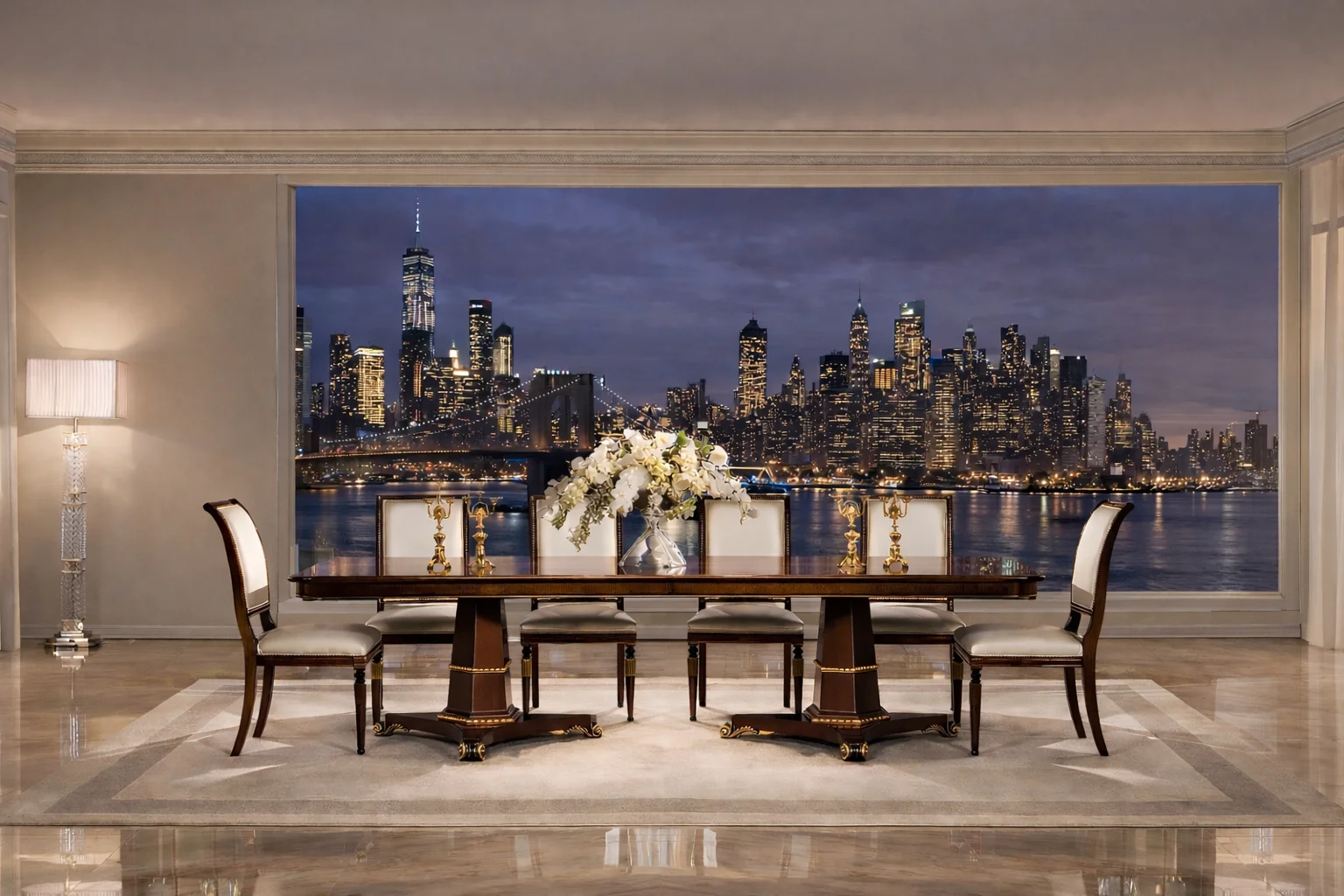
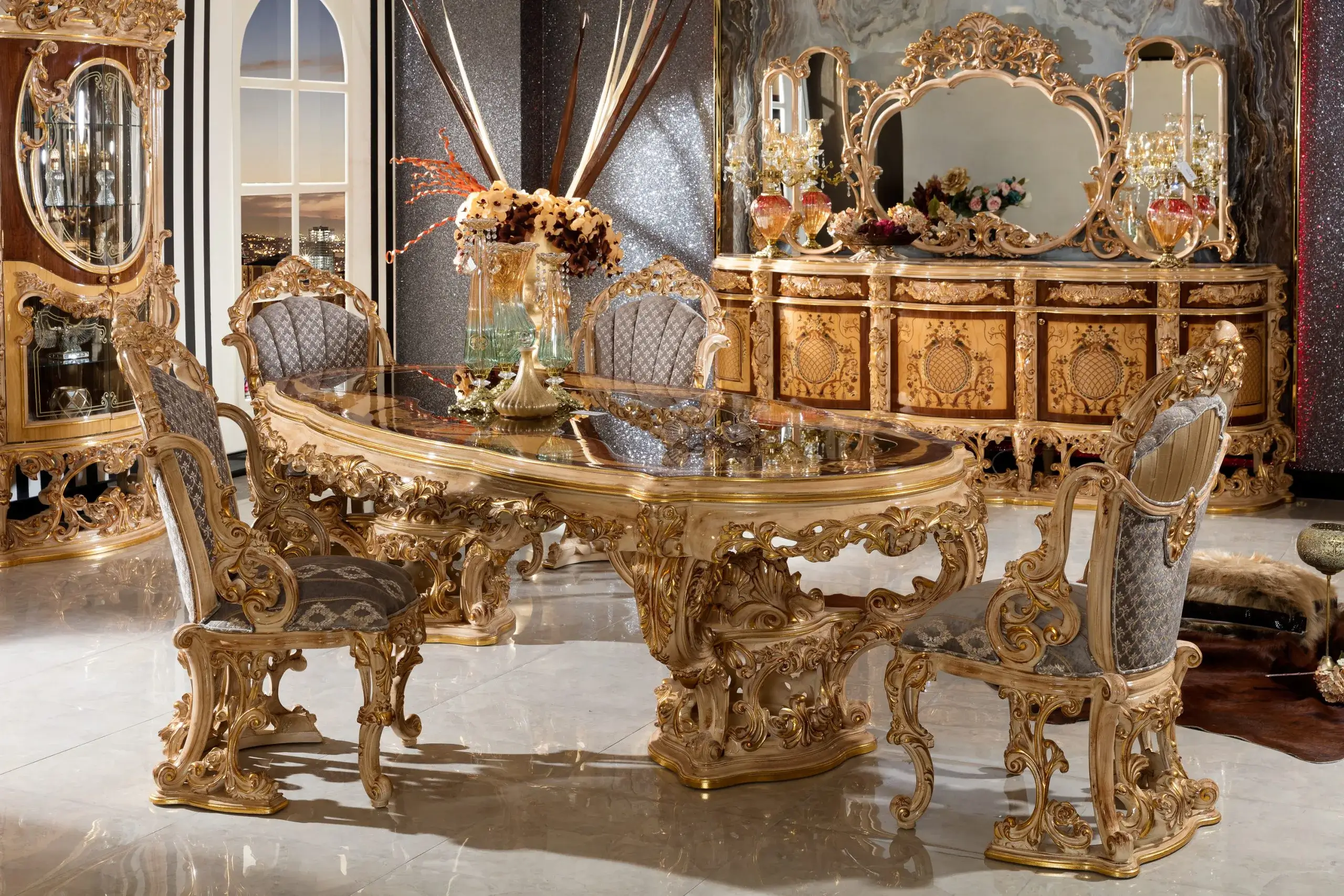
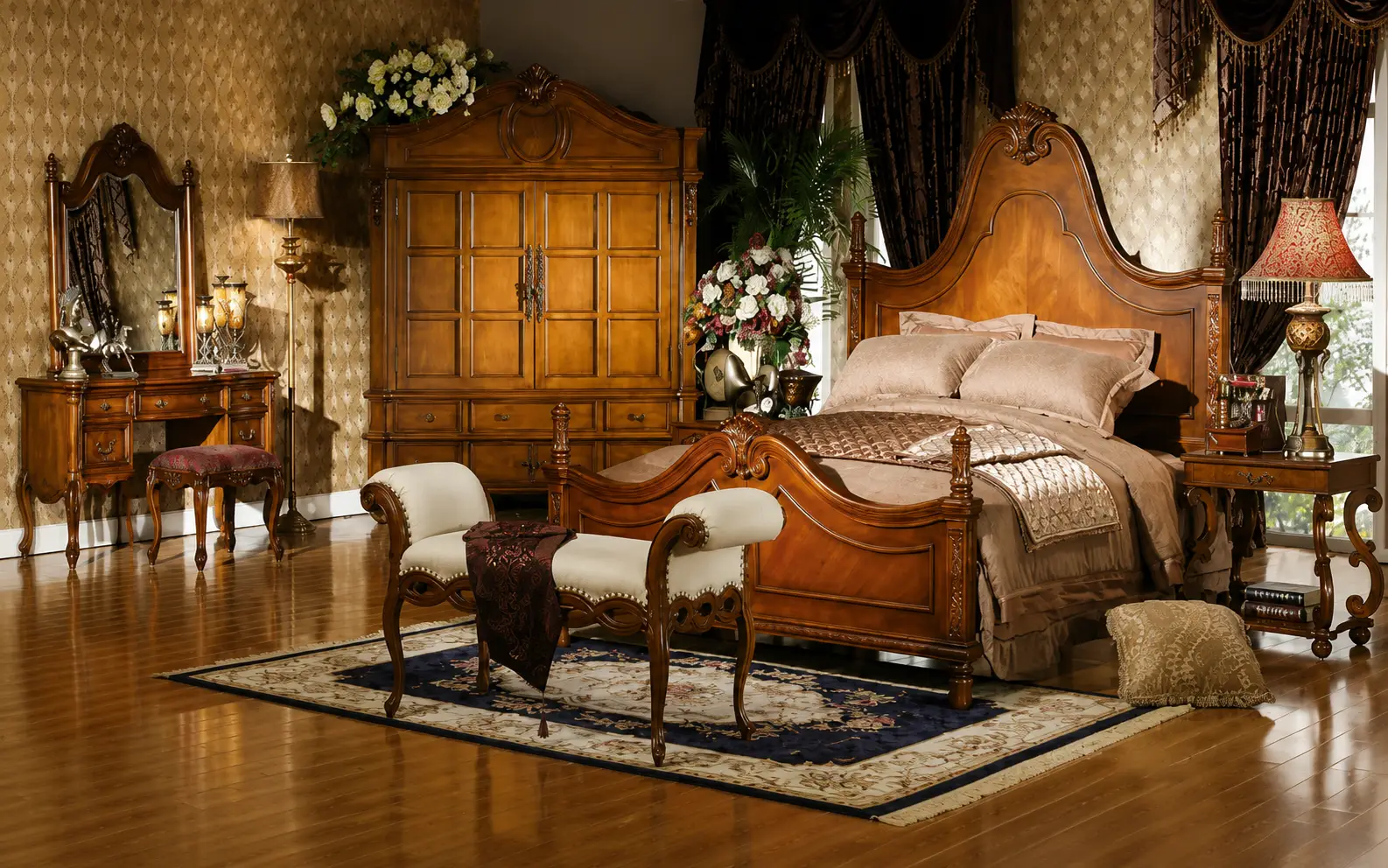
Our commissions range from single statement pieces for private residences to complete FF&E packages for boutique hotels and serviced apartment developments. We have built four-poster beds for penthouse suites, hand-carved divans for royal guest quarters, and full dining collections for resort restaurants. The scope of customisation is comprehensive: carved panel designs, lacquer and antique finishes, bespoke upholstery, and non-standard dimensions configured to architectural drawings. The common factor across every project is that nothing leaves our factory as a standard item.
Why UAE Clients and Interior Designers Specify Indian Carved Furniture
The decision to source handcrafted furniture from India is rarely about cost alone. It is about what Indian craftsmanship delivers that alternatives — European luxury brands, regional manufacturers, imported Asian production — consistently cannot.
The craft is not replicable at scale elsewhere. The depth of relief carving produced in India's established furniture regions, the consistency of repetitive motif across a large hospitality commission, the integrity of joinery on a solid wood frame — these are the benchmarks experienced UAE interior designers recognise on contact. Mechanised production does not get there.
Customisation here means manufacturing from scratch, not selecting from a menu. European luxury brands offer customisation within defined parameters: fabric options, finish variants, perhaps dimensional adjustment. We build from specification. A Dubai villa developer needing a ten-seat dining table in precise dimensions with carved apron detailing matched to the property's architectural language gets exactly that — not an approximation. For hospitality projects specifying consistent output across forty guest rooms, we replicate to exact standard without quality variance across the production run.
The pricing reflects manufacturing economics, not compromised materials. Direct access to teak supply and the cost structure of skilled handcraft labour in India allows us to price commissions at a point no European manufacturer producing equivalent work can approach. The difference in landed cost typically funds a higher finish specification, a larger commission scope, or both — outcomes that serve the client directly.
Solid teak construction means the furniture is what it appears to be. We do not use engineered wood cores or veneered surfaces in our export collections. The carving goes into the wood. The joinery is structural. What arrives at Jebel Ali Port is precisely what was specified at the order stage.
Bulk hospitality supply is a core capability. Hotel developers and FF&E procurement teams commissioning large UAE projects need a manufacturer who can manage volume production, quality-consistent output across units, and coordinated container shipment timed to site readiness. We have delivered multi-container hospitality projects on schedule, including phased clearance arrangements coordinated with site construction timelines.
Shipping Handcrafted Furniture from India to UAE — The Actual Process
Logistics is where reputations are built or damaged. We have shipped from Nhava Sheva (JNPT) to Jebel Ali for two decades and can describe the process without generalities.
Transit time from Nhava Sheva to Jebel Ali is typically 12 to 18 days by sea freight. For large villa or hospitality commissions, FCL (full container load) is almost always the right structure — it minimises handling, allows optimal internal packing configuration, and gives the client a single container identity for customs reference. LCL (less than container load) is viable for smaller residential orders but requires more robust individual packaging given consolidated cargo handling.
Total lead time from order confirmation to UAE project site delivery is typically 8 to 14 weeks, depending on production complexity and commission scale. We issue a detailed production and shipment schedule at the order stage so interior designers and project managers can plan site access and installation with precision.
Export-grade wooden crating is standard, not optional. Each piece is wrapped in bubble cushioning and polyfoam before being positioned in a purpose-built wooden crate dimensioned to the piece itself. Crates are internally braced to prevent movement under sea freight conditions. Fragile carved elements — finials, corbels, decorative relief panels — receive additional localised protection. Photographs of packed and crated items are shared with clients before container loading, and a complete packing list with gross weights and dimensions accompanies every shipment.
We operate on both FOB and CIF terms. FOB suits clients with established freight forwarders in Dubai or Abu Dhabi who manage their own insurance and onward logistics. CIF is the cleaner arrangement for private villa clients and interior designers without a dedicated logistics function — we handle freight booking, marine insurance, and documentation through to port of discharge. In both cases, we work with freight forwarders who have active UAE agent relationships on this specific trade lane.
UAE Port Entry: Jebel Ali, Khalifa Port, and Inland Clearance
The UAE's port infrastructure is among the most efficient in the world. Knowing which entry point applies to your project is the starting point for logistics planning.
Jebel Ali Port (Dubai) is the default gateway for the majority of our shipments — furniture destined for Dubai, Sharjah, and the Northern Emirates routes here as a matter of course. Operated by DP World, Jebel Ali's inland connectivity and established freight agent network make it the most practical entry point for most residential and hospitality deliveries. Our clearing agents maintain active relationships at Jebel Ali, which directly reduces customs processing timelines.
Khalifa Port (Abu Dhabi) is the correct entry point for projects in Abu Dhabi and the Western Region. For large-format hospitality and palace commissions in the capital, we route directly to Khalifa rather than transshipping through Dubai — it is faster and more cost-efficient for Abu Dhabi-based project sites.
Dubai ICD (Inland Container Depot) and bonded storage arrangements are available for phased delivery projects — particularly relevant for large hospitality FF&E packages where full single-day delivery is not operationally practical. We coordinate ICD arrangements with our clearing agents when the project scope requires it.
Duties, Documentation, and Compliance — Getting It Right the First Time
Documentation errors do not just cause delays. They create costs, damage client relationships, and in some cases trigger customs examinations that hold shipments at port for weeks. After twenty years on this trade lane, our documentation process is precise because it has to be.
HS Code 9403 is the correct classification for wooden furniture for domestic or commercial use — the category that covers our entire export range. Accurate HS code declaration is essential for correct duty assessment and municipality clearance. Misclassification, even inadvertent, triggers customs examination.
UAE import duty on furniture under HS Code 9403 is typically 5%, calculated on the CIF value of the shipment. Clients importing through UAE free zones should confirm their duty treatment with the relevant free zone authority prior to shipment, as the standard rate may not apply. Our commercial invoices and packing lists reflect accurate transaction values — we do not inflate or deflate declared values under any circumstances.
Fumigation certification is mandatory for all solid wood furniture exports to the UAE. All our furniture and export crating is treated in compliance with ISPM 15 (International Standards for Phytosanitary Measures), and fumigation certificates are issued by an accredited agency as a standard part of our export documentation. Shipments arriving without valid fumigation certificates are held at port. This is not a contingency worth testing.
The standard documentation set for each shipment includes: commercial invoice, packing list, Bill of Lading, certificate of origin (India), fumigation certificate, and where required, a quality inspection certificate. For hospitality and government projects in Abu Dhabi, additional municipality clearance documentation is often required — we coordinate this with the client's local PRO or consultant well in advance of the shipment date.